
Explainer
Mortgage Fee Sheet: 9 Red Flags Texas Homebuyers and Agents Should Catch Before Making an Offer
By Charlie Braden (Broker/Owner, NMLS #1283114) and Will Braden (Mortgage Broker, NMLS #2472530), J. Charles Lending · From the Beyond the Rate podcast
The short version: Before you make an offer, get a full fee sheet that starts from the par rate: the rate you qualify for without paying points and without a lender credit. Then check for inflated lender fees, marked-up third-party fees, sloppy prepaids, and seller credits the lender assumed you’ll get. If a quote only shows a bought-down rate or a pre-approval letter with no costs, you don’t have enough information to shop or negotiate.
Rates have been elevated since 2022, and that has changed how many lenders quote. More and more, we’re seeing rate quotes that already include one to three points of buydown, estimates that assume the seller will pay for it, and pre-approval letters with a rate on them and nothing else.
That leaves two people in the dark. The buyer doesn’t know the true cost of the loan. And the buyer’s agent can’t negotiate well, because you can’t ask a seller for the right amount of concessions if you’ve never seen what the loan actually costs.
This guide walks through what a normal fee sheet looks like, then the red flags we see most often on other lenders’ estimates. All the examples are real fee sheets that buyers brought to us.
Start Here: Always Ask for the Par Rate
Every loan has a range of rate options, sometimes called the rate stack. You can pay points to lower the rate, take a lender credit in exchange for a higher rate, or take the rate in the middle where you neither pay nor receive anything. That middle rate is the par rate.
The par rate is the honest starting point. It shows what the loan costs before anyone starts paying to change it. Buying the rate down can be a smart move, but it’s a decision, and you can’t make it without seeing what you’d be paying for.
Here’s a common example of what not to do: a rate update a loan officer sent out to agents. Notice that the advertised rate already includes a one-point buydown.
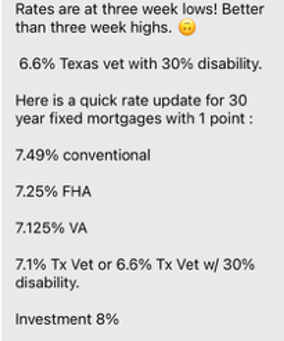
Loan officer’s text “rate update” for 30-year fixed mortgages quoted with one point (including the Texas Vet rate)
A rate quoted “with one point” is a bought-down rate, not a starting point.
A note on Texas Vet loans
The Texas Vet program often shows an attractive advertised rate, but that rate comes with a mandatory 1% participation fee, which works out to a built-in one-point buydown. Because lenders earn little on state-funded programs (the same is true of most down payment assistance programs), many also add their own origination fee or admin fees. Add it up and it’s a lot of fees to reach a rate that a broker can often reach for less. Texas Vet can still make sense for some veterans, especially those with lower credit scores who have cash or seller help to cover the costs. But compare it against a standard VA loan at par before deciding.
Ask your lender: “What’s my par rate, with no points paid and no lender credit, and what does my cash to close look like with zero seller concessions?”
What a Normal Fee Sheet Looks Like
Before looking for red flags, it helps to know what “normal” looks like. Every fee sheet should be organized into roughly these sections:
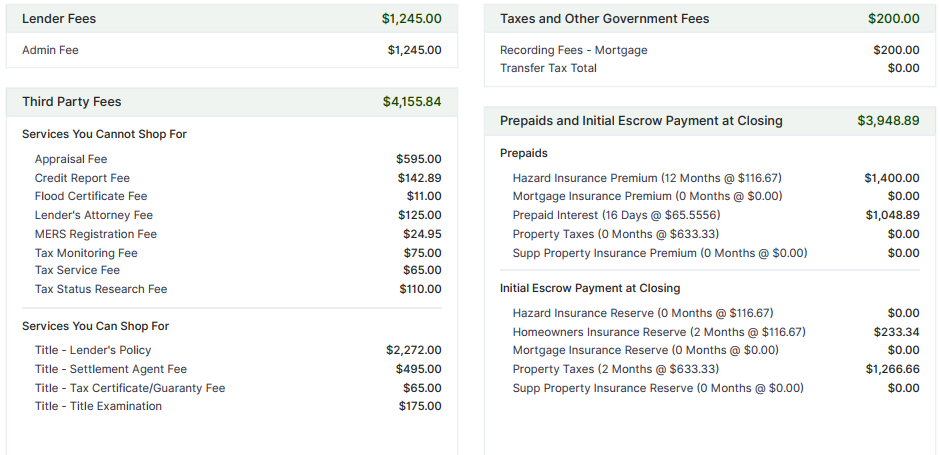
*Sample mortgage fee sheet showing lender fees, third-party fees, title fees, and prepaids
| Section | What’s in it | What’s normal |
|---|---|---|
| Lender fees | Admin, processing, or underwriting fee | Usually one fee in the ~$995–$1,500 range. Some lenders fold it into the rate pricing instead of listing it. Either way, you pay for it. |
| Third-party fees | Appraisal, credit report, recording fees | Passed through at cost. Our credit report fee is $142.89 because that’s exactly what we’re charged, whether it’s one borrower or a couple. |
| Title fees | Lender’s title policy, escrow and settlement fees | Set by the title company. In Texas the seller customarily pays the owner’s title policy. |
| Prepaids & escrow | Homeowner’s insurance, property taxes, prepaid interest | One full year of insurance paid up front, plus a few months of taxes and insurance to start your escrow account. Prepaid interest covers the days from closing to the end of that month. |
Prepaids aren’t really “loan costs.” You’d pay for insurance and taxes whether you had a mortgage or not. But they’re part of your cash to close, so they need to be accurate.
9 Red Flags to Watch For
Red Flag 1 – The quote starts with a bought-down rate
If the first rate you see already includes points, you have no idea what the loan costs at par. A rate with one to three points baked in can look great next to an honest par quote from another lender, even when the other lender is actually cheaper.
Red Flag 2 – A pre-approval letter with a rate, but no fee sheet
A pre-approval letter tells you that you can borrow. It doesn’t tell you what the loan costs. If all you have is a letter with a rate on it, you don’t know how the lender got to that rate, and neither does your agent. You should have a full, itemized fee sheet before you start writing offers.
Red Flag 3 – A large broker or origination fee you weren’t told about
In the example below, the buyer received a pre-approval letter with a rate three weeks before seeing this estimate. The estimate revealed a broker fee of 2.5% of the loan amount, plus admin fees, for over $8,000 in loan costs. And the rate wasn’t even a good one.
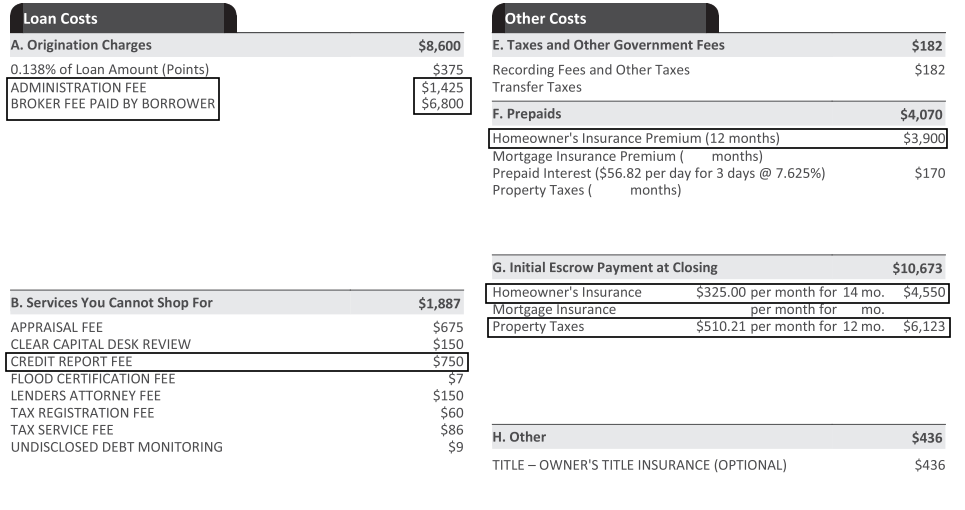
*Fee sheet showing the 2.5% broker fee, $750 credit report fee, doubled homeowner’s insurance, and full-year property taxes
This one estimate contains Red Flags 3, 4, and 5. Cash to close was about $15,000 higher than it should have been.
Red Flag 4 – Marked-up third-party fees
The same estimate charged a $750 credit report fee. A typical credit report runs around $150 or less. Third-party fees should be passed through at cost. When one is several times the normal amount, the lender is adding profit to it, and it’s worth asking what else is padded.
Red Flag 5 – Prepaids that don’t add up
That estimate also collected 12 months of homeowner’s insurance and 14 months of insurance in escrow, double-counting it. It also had the buyer paying a full year of property taxes up front, when buyers normally put only two to three months into escrow and the seller credits the rest at closing.
Mistakes like these push cash to close way up. Worse, this estimate arrived about a week before closing, sent to first-time buyers who had no way to know it was wrong. A loan officer who doesn’t get the initial disclosure right is telling you something about how the rest of the file will be handled.
Red Flag 6 – Too few days of prepaid interest
Prepaid interest covers the days from your closing date to the end of that month. If you close on the 5th, that’s roughly 25 days of interest, which can easily be $1,400–$1,500 on a typical loan. If you close on the 28th, it’s only a few days.
Some loan officers list just a few days no matter when you’re closing. It makes cash to close look lower on paper, and the real number shows up later. Check the closing date against the number of days listed.
Red Flag 7 – “Third-party processing” or “fulfillment” fees
Look in the “services you cannot shop for” section. If you see a third-party processing fee or a fulfillment fee, it usually means your loan officer is handing your file to an outside company to do the work from contract to close. In the example below, those fees added $1,445, paid by the buyer.
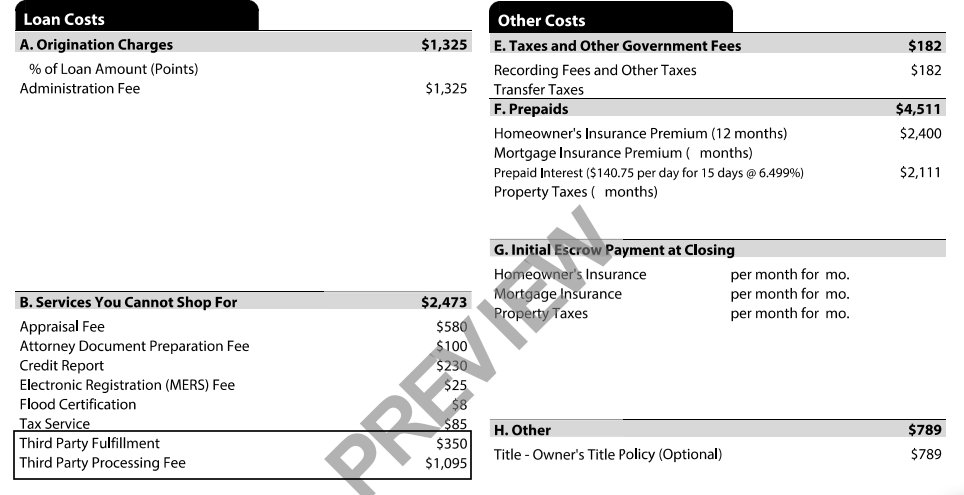
*Fee sheet showing third-party fulfillment and third-party processing fees
In this case the rate itself was competitive. But the estimate was even emailed by the outside processing company, not the loan officer. You’re paying extra for someone else to do the job of the person you chose to work with. When you shop for a lender, ask who will actually be working your file.
Red Flag 8 – Massive discount points built in before you’ve found a house
The next estimate was from a direct lender. It had a processing fee and an underwriting fee totaling almost $2,000, and then 5.5% of the loan amount in discount and origination points, about $30,000, to reach the quoted rate. For comparison, we could have delivered that same rate for closer to $20,000 in buydown.
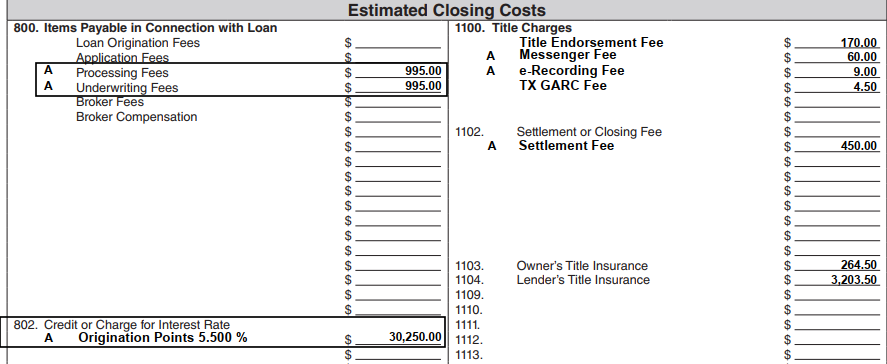
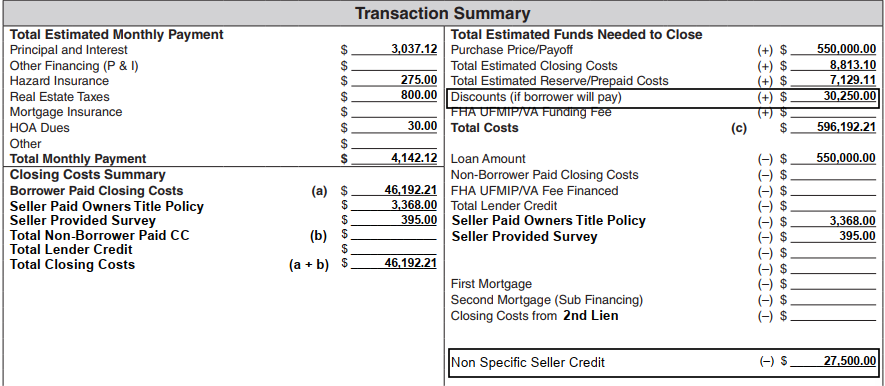
*Direct lender estimate with processing + underwriting fees, 5.5% in discount/origination points, and a $27,500 non-specific seller credit
Buying down a rate isn’t wrong. But you should know that’s what’s in your quote, and you should see what the rate would be without it.
Red Flag 9 – Seller credits assumed before any offer is made
Look at the bottom of that same estimate: a $27,500 non-specific seller credit, about 5% of the purchase price, before the buyer had even made an offer. Plugging it in made cash to close look manageable. Remove it, and the real number is much higher.
The same lender sent a second estimate without the seller credit. That one showed the honest cash to close of $17,696, but it still didn’t show what the rate would be without paying the points.
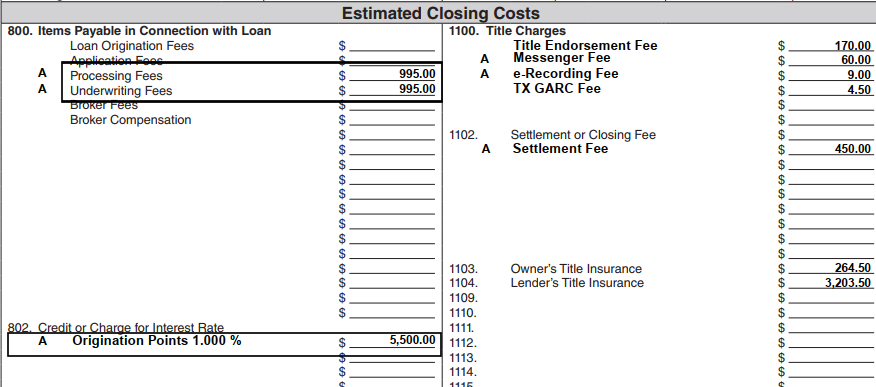
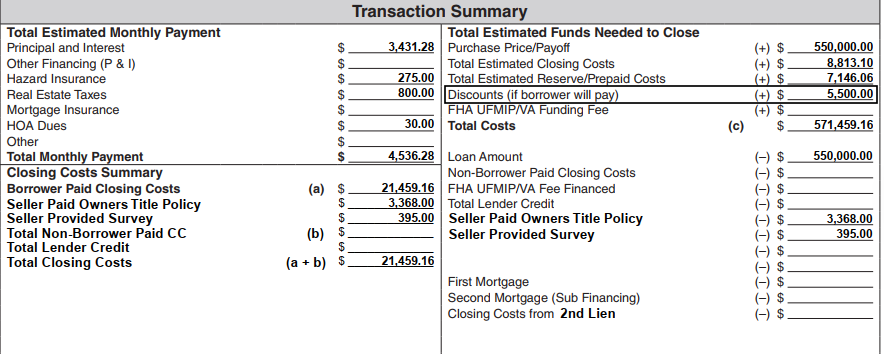
*Same lender’s second estimate: no seller credit, cash from borrower $17,696, still no par rate shown.
The right way to handle this is to show the buyer’s full cash to close with no seller credits, then tell the agent plainly: “After seller-paid title, the buyer needs $X to cover closing costs.” That number is what the agent goes and negotiates for.
For Real Estate Agents: Why You Need This Before Writing the Offer
If you represent buyers, the lender’s fee sheet is your negotiating playbook. Without it, you don’t know whether to ask for $5,000 or $25,000 in concessions, or whether the buyer is counting on a rate buydown the seller hasn’t agreed to pay for.
Ask the lender for a fee sheet that shows the par rate, full cash to close with no seller concessions, and the cost of any buydown option listed separately. Then you can write an offer that actually works.
Already Under Contract? It’s Not Too Late to Shop
Many buyers feel locked in once they’ve signed a contract. You’re not. If your official Loan Estimate shows costs you weren’t told about, you can still get another quote and move your loan. A lender who emphasizes how complicated and in-depth their process is, but won’t clearly show you their costs, is hoping you’ll feel too far along to switch. Most loans are fairly straightforward when everyone is on the same page, and a good lender can step in.
Your Fee Sheet Checklist
- The par rate is shown, with no points paid and no lender credit
- Any buydown option is listed separately with its exact cost
- Lender fees are clearly itemized (typically one admin, processing, or underwriting fee)
- Third-party fees like the credit report look reasonable and are passed through at cost
- No third-party processing or fulfillment fees, or you know exactly why they’re there
- Homeowner’s insurance is counted once for the year, plus a few months in escrow
- Property taxes in escrow are a few months, not a full year
- Prepaid interest days match your expected closing date
- Cash to close is shown without assumed seller credits
- You have all of this before making an offer, not just a pre-approval letter
Common questions
What is a par rate on a mortgage?
No buydowns, no credits. The par rate is the interest rate you qualify for without paying discount points and without receiving a lender credit. It’s the baseline every quote should start from so you can compare lenders fairly.
What’s the difference between a fee sheet and a pre-approval letter?
One is just an approval for the loan, the other shows the cost. A pre-approval letter confirms you can likely borrow up to a certain amount. A fee sheet itemizes what the loan will cost, including lender fees, third-party fees, prepaids, and your cash to close. You need both before making an offer.
Can I switch lenders after I’m under contract in Texas?
Yes. Being under contract doesn’t lock you into a lender. If your Loan Estimate shows costs you weren’t told about, you can still shop and move your loan, as long as there’s enough time before closing. We routinely get loans closed in 2-3 weeks.