
Explainer
Tracking Mortgage Rates? Here’s What to Follow
When it comes to the factors that affect mortgage rates, there’s probably more misinformation out there than correct information. Most of the inaccuracies revolve around some version of “I’m just going to wait for the Fed to drop rates.” On one hand, you can’t blame the average person for thinking the Fed Funds Rate drives mortgage rates. On the other hand, you can definitely blame the “experts” who give the Federal Reserve more credit than it’s due. Here, we’ll dispel that myth as succinctly as possible and show you what you should actually be focusing on.
First, our article on Why a Fed Cut Doesn’t Lower Your Mortgage Rate goes into more detail on the Fed Funds Rate and the evidence against it driving mortgage rates. But start with the Fed’s mission: to promote full employment and control inflation. It’s that second goal they try to manage through the funds rate — and they’ve done a less than spectacular job of it.
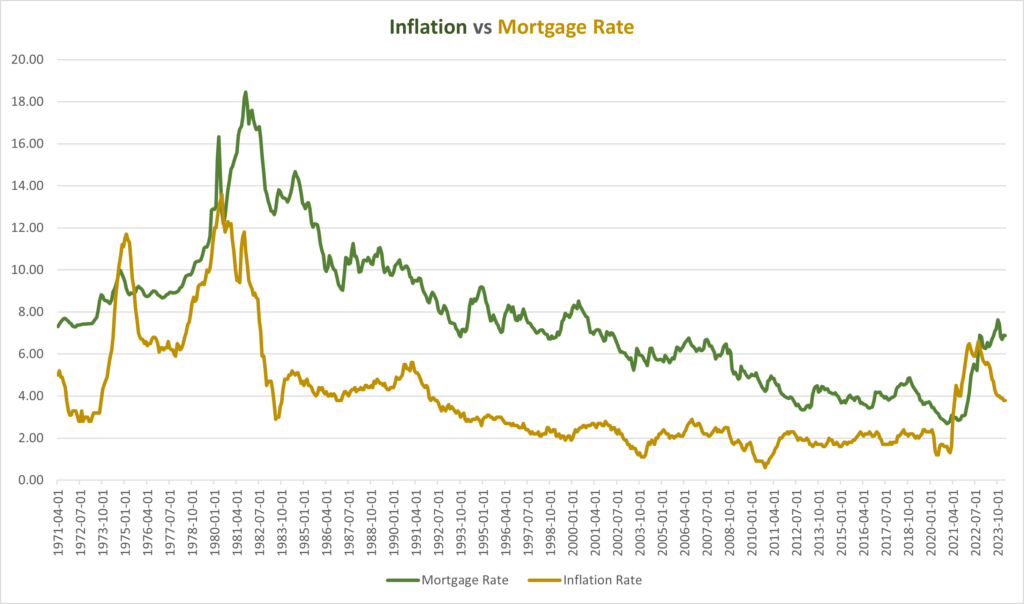
Second, what you should actually be tracking is the rate of inflation. No other metric tracks mortgage rates more closely. As you can see in the chart below, we’ve plotted the rate of inflation against the average 30-year fixed mortgage rate going back to 1971. If there’s one thing you can’t ignore, it’s that inflation moves and mortgage rates follow — every single time. Throughout the 1970s, inflation skyrocketed and so did mortgage rates. Once inflation got under control in the early ’80s and stabilized through the 2010s, mortgage rates settled into a slow, steady downward trend.
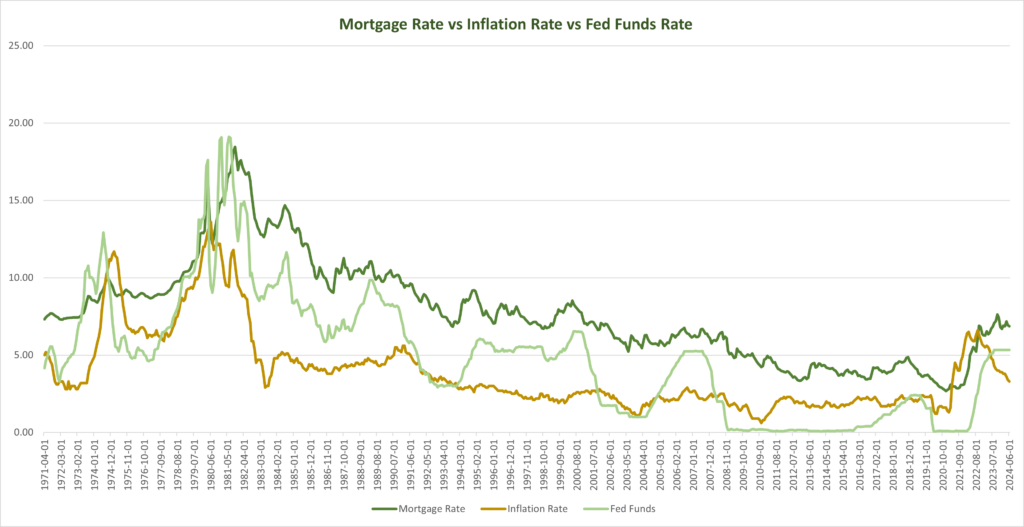
Now compare that with the chart below. Here we’ve added the Fed Funds Rate going back to 1971. As you can see, the Fed Funds Rate moves up and down regardless of the rate of inflation or the average 30-year fixed mortgage rate. If you take the Fed at its word that one of its goals is to control inflation, then as this chart shows, it has done an incredibly poor job of it. In the early 1970s, before inflation started to skyrocket, the Federal Reserve drastically raised the funds rate — with little success. Inflation skyrocketed anyway, and mortgage rates followed. For a more recent example, look at 2020 through 2021: the Fed Funds Rate sat near zero, yet inflation spiked in 2021 and mortgage rates followed right along with it. The Federal Reserve didn’t raise its funds rate until the middle of 2022. If controlling inflation is really the goal, it’s safe to say the Fed showed up late to the party.
With plenty of evidence to back up the case that mortgage rates follow inflation, there are two metrics you should be tracking if you’re trying to decide whether mortgage rates will rise or fall:
1. Consumer Price Index (CPI) — a monthly inflation index that tracks how much prices have risen or fallen for what consumers are paying at the retail level.
2. Producer Price Index (PPI) — a survey of what businesses are paying for the goods and services they need to manufacture or deliver their products, i.e., the costs businesses incur before products reach the consumer level. The PPI carries less weight than the CPI, but it can offer a preview of where the CPI is headed several months out, as businesses decide whether to pass their rising costs on to consumers.
Common questions
Why do mortgage rates follow inflation?
Inflation is the increase in cost, mortgages are still a product. Just like any product you buy off the shelves, you are borrowing money and paying for a service. Inflation is defined as too many dollars chasing too few products. The product in this case is money, so if money gets more expensive so do mortgage rates.
Is there anything else that affects mortgage rates.
Yes, economic data and reports. Reports to track would mostly be the Gross Domestic Product (GDP) and the unemployment rate. Typically when economic reports are good investments flow into the markets and away from mortgage bond, which causes rates to tick up. Obviously the inverse happens. This does not create a trend, these reports will cause short term spikes or reductions.
Is there something else that moves the same way mortgage rates do?
The 10 year Treasury Yield. This is the other product that moves just about in lock step with mortgages. Typically the 10 Yr yield is about 1.75%-2% lower than the average mortgage rate. If you track the 10 Yr movement then you can assume mortgage rates are moving in the same way.