
Explainer
Is the Economy Actually as Bad as People Think? A Data-Driven Look
“I’m worried about the economy” is one of the most common objections we hear from prospective buyers right now and it’s completely understandable. But it’s also a broad, catch-all statement that usually bundles together five or six separate concerns: inflation, jobs, GDP, oil prices, and general uncertainty. When you break those pieces apart and look at what the data actually shows, the picture is more nuanced and in several areas, more encouraging than the headlines suggest.
Here’s a sector-by-sector breakdown of where things actually stand.
Mortgage Rates: A Series of Lower Peaks
Since the post-pandemic spike that pushed the average 30-year fixed rate to roughly 8% (as tracked across Freddie Mac, Mortgage News Daily, and other major indices), rates have been on a step-down pattern rather than a straight line. We’re now on the fourth distinct peak since that high, and each peak has been lower than the one before it. That’s the definition of a downward trend, even though it doesn’t feel that way when you’re living through one of the upswings.
The current uptick traces back to the Iran conflict. Geopolitical shocks like this are usually deflationary on their own, money moves into safe-haven assets and rates tend to ease. But this particular conflict carries an oil-supply dimension, and rising oil futures pushed inflation expectations higher, which is what actually moved mortgage rates upward again.
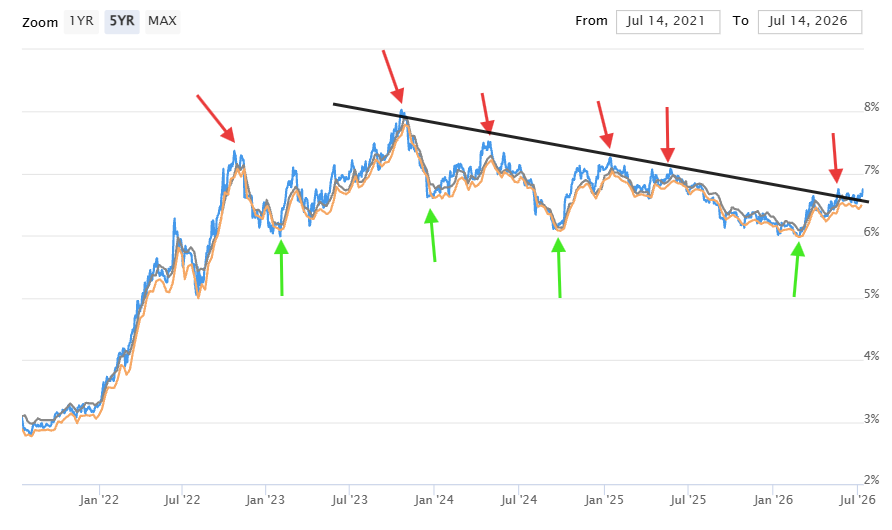
The more important number for buyers to watch isn’t the peak, it’s the floor. Every time rates have approached 6% since mid 2023, they’ve held right around that level without breaking through. That floor has proven remarkably consistent across multiple cycles.
Why this matters for buyers on the fence: when rates have dipped near 6% in the past, mortgage applications have spiked every time. More applications means more competing buyers, which works against the negotiating leverage buyers currently have. Locking in today’s rate on a well-negotiated deal, with the option to refinance if rates do eventually break below 6%, is often the more strategic play than waiting for a rate that may arrive alongside a much more competitive market.
The Real Signal: Inflation, Not the Fed Funds Rate
We’ve said this before and the data keeps confirming it: the fed funds rate is a poor predictor of mortgage rate direction because it’s a short-term policy tool influenced by multiple mandates, not just inflation. Inflation itself is the more reliable indicator to watch.
Right now, inflation has leveled off. Part of that is simply the economy adjusting to the oil price increases from a few months back, once businesses absorb a cost shock and prices stabilize, the inflationary pressure from that shock fades even if prices don’t fall back to where they started.
The Fed’s public posture has trended more hawkish in tone, but the underlying signal is one of patience: the Fed wants more data before making a move in either direction, which suggests a “hold” is the most likely near-term outcome. That’s actually a constructive signal. When Fed officials indicate they aren’t planning to hike, markets read that as confidence that inflation is stable, and mortgage bonds and treasuries have responded accordingly. The commentary from Fed speeches tends to move markets more than the actual rate decisions themselves, because it’s the direction of travel the market is pricing in, not the current level.
Employment: A Government Story, Not a Private-Sector Story
Unemployment has ticked up slightly over the past year, sitting around 4.1%. But the composition of that increase matters. The bulk of it is tied to public-sector reductions, federal and state government positions affected by budget-tightening efforts, rather than broad private-sector weakness. Private employment has actually held steady or grown modestly over the same period.
This distinction matters because it tells you what the Fed is and isn’t reacting to. If the Fed were genuinely worried about a weakening labor market, a rate cut would be the natural policy response, that’s one of the primary levers available to stimulate hiring and business expansion. The absence of that signal suggests the Fed doesn’t view unemployment as the priority concern right now.
GDP and Recession Risk: The Indicators Aren’t There
GDP has maintained its long-term upward trend, with COVID standing out as the singular major disruption in the multi-decade chart. There’s no current sign of GDP contraction. Recessions are typically preceded by a meaningful rise in layoffs, and that leading indicator simply isn’t showing up in the data right now. Certain sectors may be under pressure, but broad economic output is not currently flashing a recession warning.
Oil Prices: A Supply Story With a Geopolitical Trigger
Oil has spiked over the past several weeks, driven primarily by the Iran conflict and supply concerns around the Strait of Hormuz, pushing benchmarks like WTI, Midland, OPEC, and Dubai crude into the high-$80s to high-$90s range. This is a genuine cost pressure for any industry reliant on transportation and energy, and it flowed through into the May/June inflation data.
Since then, prices have stabilized in the $80–90 range as businesses that could absorb the temporary cost increase did so without passing it on, and the initial shock has worked its way through the system. If the Iran conflict resolves and Strait of Hormuz supply concerns ease, there’s a reasonable path to oil, and the transportation and inflation pressure tied to it, moving lower from here.
Consumer Confidence: A Blunt Instrument
Consumer confidence readings are low right now, but it’s worth being clear-eyed about what that survey actually measures: a general “how do you feel about the economy” question that doesn’t distinguish between someone worried about their job, someone worried about grocery prices, and someone who simply can’t make a large purchase for unrelated reasons. It’s a useful gauge of sentiment, but it’s not a diagnostic tool and low confidence readings can be disproportionately dragged down by a single major concern even when other fundamentals are holding up.
Right now, that single dominant concern is likely the Iran-driven volatility layered on top of an economy that had otherwise been finding its footing. That’s a transitionary disruption, not a structural one, and it’s reasonable to expect sentiment to firm back up as that situation resolves.
What About AI?
It’s a fair question, and a fair concern: will AI eliminate jobs faster than it creates them? History offers a useful, if imperfect, guide. Every major technological shift, from the cotton gin to the automobile, followed a similar arc: certain roles were displaced, but the efficiency gains created new industries and roles that didn’t previously exist. Fewer people picking crops led to more people processing and distributing food. Fewer buggy-whip makers led to an entire automotive supply chain.
The early data on AI adoption points in a similar direction, increased efficiency is already showing up as a net positive in several sectors, including ones people initially assumed would be disrupted. The more likely outcome isn’t “job eliminated,” it’s “job transformed.” That’s a real transition to manage, but it’s not the same thing as an economic headwind.
The Bottom Line
“The economy” isn’t one thing, it’s several. Mortgage rates are on a lower-peaks trend with a proven floor. Inflation has leveled off and the Fed appears to be in wait-and-see mode rather than tightening mode. Unemployment softness is concentrated in the public sector, not the broader labor market. GDP shows no recession warning signs. Oil is elevated but plateauing, tied to a specific geopolitical event rather than a structural supply problem.
None of that means there’s nothing to watch. But when clients tell us they’re “concerned about the economy,” the most useful next step is usually to ask: which part? Once you isolate the actual concern, it’s almost always more manageable and less disqualifying for a home purchase decision than the broad statement suggests.
Have a specific concern about how any of this affects your buying timeline? Reach out, we’re happy to walk through it.