
Analysis
Pre-Election Home Buying Game Plan: A How-To for Buyers and Realtors
Buyers can lock in today’s purchase price and still keep a shot at a lower rate if rates fall after Election Day on November 3. Prices and rates are two separate decisions, and a plan that handles them separately gives buyers more control.
This guide walks through that plan step by step, shows two real-world scenarios, and explains how realtors can use it with clients. It builds on our recent market update, where hotter-than-expected inflation reports still pushed mortgage rates down by about a quarter point.
The plan, step by step
Work backward from the calendar. Election Day is the first major catalyst, and most contracts run 30 days or more.
- Go under contract within the next week or so. That leaves about 10 days before the election.
- Negotiate the price, not just the rate. Our target is a 5% to 10% discount from list, since sellers right now often have to sell.
- Extend the timeline. A normal contract is 30 days. Stretch to 45 days, with a 20-day option period, so you can still close after the market reacts.
- Lock a rate you can live with. The average 30 year fixed conventional rate is 7.4%, while our conventional buyers are seeing around 7.125% to 7.25% today.
- Be ready to re-price. If rates drop after the election, either renegotiate with the same lender or move the loan to another lender at something like 6.875% or 6.75%.
- Close before Thanksgiving. Even with a lender switch, the timeline can still work.
The election may or may not move rates. This plan works either way, because the price you negotiated is already locked in.
Why the loan structure matters
Step 5 only works if your loan can move. Most retail banks and direct lenders keep you in their own loan, so getting a better rate means starting over with a new lender and a new appraisal.
As a broker, we work with six lenders and can move a loan to another one when the numbers justify it. We don’t do this routinely, but it is available.
Appraisals are the second advantage. On a conventional loan, a bank or direct lender has to order a new appraisal if you switch. A broker can transfer the existing one. FHA and VA appraisals already transfer, but conventional ones normally don’t.
With the appraisal done, we can close in about 8 days. We have closed deals in 12 days even when we had to order the appraisal.
Scenario 1: the offer that never got made
A recent client found a home listed at about $380,000. He didn’t talk to us until late, and he hesitated to make an aggressive offer. By the time he was ready, the price had dropped to $350,000. That reduction drew new buyers and a small bidding war.
Here is what could have happened instead. Suppose he had offered $355,000 with $10,000 in seller concessions, roughly $25,000 below the original list price. The seller was probably about to cut to $350,000 and expected to give concessions anyway. That offer likely draws a counter, and the two sides probably meet somewhere reasonable.
The lesson: just make the offer. Many sellers right now need to sell and will take big haircuts. You never know a seller’s situation until you ask, and the offer is how you ask. Hesitation can cost more than a low offer ever will.
Scenario 2: why waiting for 6% rarely saves money
You may see advice online along these lines: a house listed at $450,000 can be bought at $425,000 with seller concessions today. When rates fall to 6%, the argument goes, it will be a $500,000 house with multiple bids over asking, so waiting costs $100,000.
That math doesn’t hold up. If anyone could reliably make $100,000 on a $450,000 house, investors would already be buying them by the hundred.
The more realistic outcome is narrower. A house that sells today at $425,000 with $10,000 in concessions might sell at $445,000 with $10,000 in concessions, or $450,000 with $5,000, when demand returns. The seller’s net moves much closer to the asking price, but the price doesn’t leap by $75,000.
That difference of roughly $20,000 to $25,000, plus competition from more buyers, is the real cost of waiting. It is smaller than the headline claim, but it is real. And a rate that falls later can be refinanced or re-priced, while a purchase price cannot.
Why timing matters: mortgage applications and rates
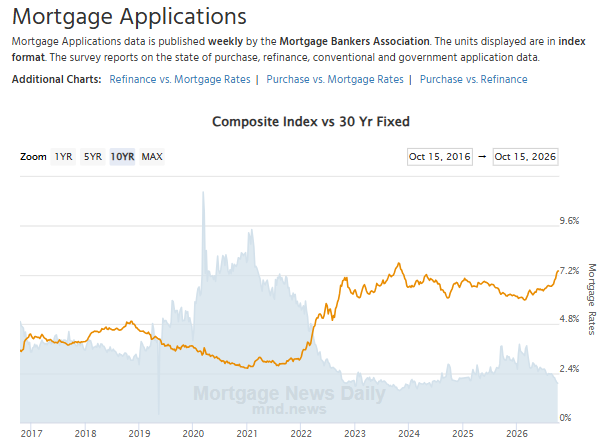
When average mortgage rates sit around 7.25% to 7.5%, weekly mortgage applications have run about 200,000 to 240,000. When rates get close to 6%, applications jump to roughly 350,000 to 400,000. That is an increase of 50% to 100%. Last week’s figure was around 199,000, which means very few buyers are active right now.
If rates drop toward 6% after the election, we expect applications to roughly double by the Spring, and demand for homes to come back with them.
That does not mean a return to 2020 and 2021. Back then, rates were extremely low and applications ran at four to five times today’s level, which is what drove the bidding wars and double-digit price jumps. We don’t expect that again, because it would take inflation near zero and rates near 2.5-3%.
What we expect looks more like 2018 and 2019: lower rates, steady applications, and a balanced market. Bids might be about concessions as much as price, and sellers who list at the right price may not have to give up much. Today’s thin market is the buying opportunity.
For realtors: using this with your clients
Your buyers may be sitting on the sidelines waiting for 6% rates. Here are ways to use this plan with them.
- Show the calendar. Walk them through the timeline backward from November 3, using a 45-day contract with a 20-day option period, although the goal would be move before Thanksgiving.
- Reframe the wait. Waiting for lower rates usually means competing with more buyers, and sellers netting closer to their asking price.
- Encourage the offer. Sellers in this market often have to sell. A reasonable offer with concessions costs a buyer nothing to try.
- Bring in the loan early. A broker who can switch lenders and transfer the appraisal keeps your client’s closing date safe even if they re-price.
- Keep the message accurate. Claims of $100,000 gains from waiting don’t hold up, and clients notice when predictions miss.
Takeaways
- Lock the price now, and keep the option to improve the rate after November 3.
- A 45-day contract with a 20-day option period leaves room for the market to move before closing.
- Make the offer. Hesitation may have cost one buyer a $25,000 price advantage.
- Waiting for 6% rates likely means higher prices, fewer concessions, and more competition.
- A broker with multiple lenders and transferable appraisals makes the plan workable.
Thinking about buying before the election? Reach out and we’ll map out the timeline with you.
This guide is for general education, not a rate quote or a prediction. Rates, prices, and terms vary by borrower, lender, and property.