
Explainer
This Isn’t the 2021 Market: Why Today’s Buyers Have the Advantage
Short answer
In 2021, low rates came with brutal competition: over-asking offers, no seller help, and buyers paying their own closing costs. Today the market has flipped. Sellers outnumber buyers, and buyers who negotiate can often get a lower price, seller-paid closing costs, and a smaller down payment. Then they can refinance when rates come down. For many buyers, that adds up to thousands of dollars less out of pocket.
Everyone says they want 2021 rates back. Far fewer remember what it took to get a house under contract that year. In this episode of Beyond the Rate, Will and Charlie compare the two markets and explain why today’s conditions may be a better deal for buyers than the rate alone suggests.
What the 2021 market really looked like
Rates were historically low, and so many buyers were competing that there were almost a million more buyers than sellers nationally. According to Redfin, here are 2021 market records:
- Median sale price rose to all time high of $386k.
- Home supply dropped to lowest level.
- 60% of homes off the market within two weeks.
- More that 50% of homes sold above list price.
The rates were great. What it took to get one was not.
What the market looks like now
Again according to Redfin, the script has flipped. Instead of a million more buyers than sellers, there are now roughly half a million more sellers than buyers. Many sellers have to sell because they are relocating or need to move on. Nice homes are getting price reductions, and savvy buyers are taking advantage:
- 59% of homes sold for under list price.
- Homes are taking an average of 4 months to sell.
- Sellers generally can’t afford to turn away an offer, so an aggressive offer is not likely to offend them. The worst outcomes are a no or a counteroffer, and a counter tells you where the seller stands.
The math: where the savings come from
Here is an illustrative example, using easy numbers, of a conventional buyer putting 20% down who negotiates $20,000 off the price and $10,000 in seller-paid closing costs:
| Source of savings | Approximate benefit |
|---|---|
| Down payment on a price $20,000 lower (at 20% down) | About $4,000 less cash needed |
| Seller concession toward closing costs | $10,000 less cash needed |
| Total out-of-pocket savings | About $14,000 |
Illustrative example only. Actual savings depend on the property, loan program, and negotiation.
Buyers often forget that a lower price also reduces the down payment. And on top of the cash savings, the monthly payment is lower. A price that is $30,000 lower can mean roughly $180 to $200 less per month from the smaller loan balance alone.
Should you put more money down or buy the rate down?
Often, no. In the example above, an extra $10,000 down payment saves only about $60 a month. Ten thousand dollars in the bank is worth more to most buyers than $60 off the payment. The same logic applies in reverse to seller concessions: $10,000 from the seller is worth about $60 a month if you convert it to a lower payment, so it usually makes sense to take the cash-savings benefit.
Buying the rate down with your own money usually isn’t worth it. Using the seller’s money to do it is a different question. The goal is the best financing scenario you are comfortable with, and for most conventional buyers that means 5% down, the typical minimum to still get good terms. Going to 20% gets you a slightly better rate and no mortgage insurance.
The real value proposition is equity: the piggy bank you start with and the one your home builds over time.
The two-stage strategy: buy well now, refinance later
Stage 1: Lower your cost basis. Acquire the home for less than list price, with the seller covering closing costs.
Stage 2: Get the lower rate when it arrives. Rates will work their way back down. When they do, we identify your target rate, or strike price. It might be 6.25% or 6%. We already have your application and documents on file, so when the rate hits your target, refinancing is nearly a push of a button.
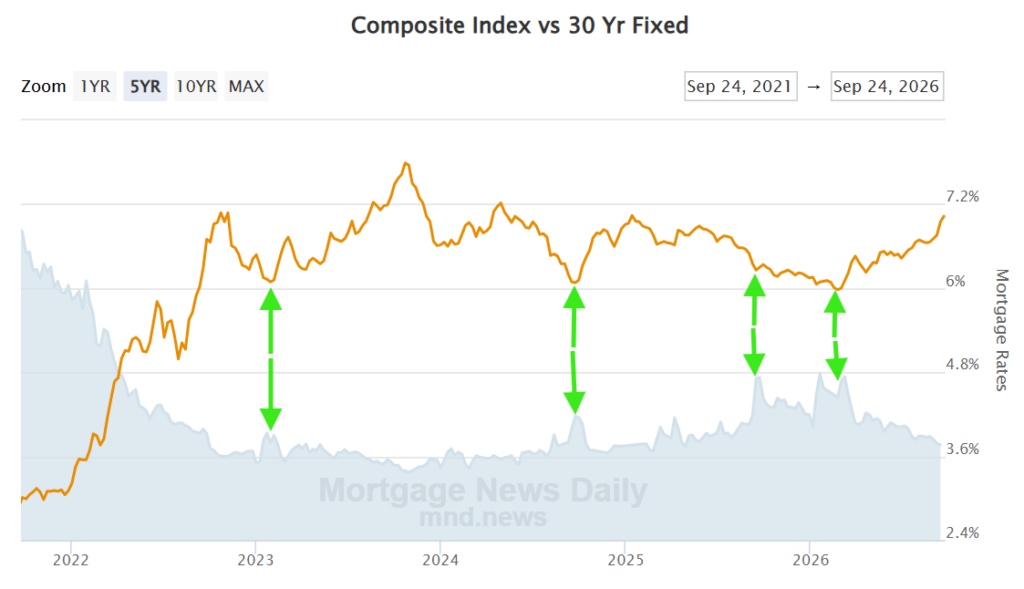
Compare that with waiting. When rates fall, everyone who has been timing the market shows up at once. The data shows it: rates approached 6% in early 2023, September 2024, and again in late 2025 and early 2026, and mortgage applications spiked each time. Those spikes are your competition jumping back into the market. Buyers who wait for 6% end up competing with everyone else who waited. And when rates do come down, homes are more likely to sell at list price than to need reductions.
The below chart shows the average 30 year fixed mortgage rate (orange line) compared against number of mortgage applications (blue shaded area). Every time rates get close to 6%, mortgage applications spiked. Some are refinances but these are also buyers jumping into the market competing for homes and turning a buyers market into a neutral one.
Already bought a new build? Watch your basis
Focusing only on the rate can backfire. Some buyers bought $500,000 new builds where the builder paid down the rate to something like 4.99% or lower. The roughly $50,000 in incentives was built into the price, so their loan balance started high. If they now need to sell, they are competing against builders’ new inventory, and they are in a tough spot. A low price basis matters if life changes and you have to sell sooner than planned.
If your client is pausing their search
Some buyers have paused after the Fed’s recent rate hike and the uptick in mortgage rates. Our advice to realtors: reverse engineer from the buyer’s monthly budget. Every buyer’s budget exists because of what they want to spend per month. If a lower purchase price keeps that payment where it was planned, even at a higher rate, then acquiring the house for $30,000 to $50,000 under list may be the better deal. Then plan around a refinance within a few years. Let the seller be the one to say no.
Rates do respond to global events. Mortgage rates began climbing right after the Iran conflict began, and we expect them to trend back down when it settles and inflation continues to cool. We can’t say when, but we know the direction. Meanwhile, sellers are ready to negotiate today.
Common questions
Is 2021’s market better than today’s for buyers?
Yes and No. Rates were lower in 2021, but competition was intense. Buyers often paid over asking with no seller concessions and paid their own closing costs. Today buyers can often negotiate below list price and get seller-paid closing costs. So each market had advantages for different reasons.
Should I wait for rates to drop before buying a home?
Short answer is no. Waiting means competing with everyone else who waited when rates fall. Buying now at a lower price and refinancing when your target rate arrives can leave you better off. Whether it does depends on your budget, plans, and timeline, so it’s worth running the numbers with a loan professional.
How does a refinance work when rates fall?
We analyze your goals and set a strike price. We set a target rate with you in advance and keep you updated to market movements. When the market reaches that target, we reactivate your file and move quickly..